

How to win back salon clients: 7 strategies that work
Losing clients? Learn why they leave and 7 proven strategies to win them back, including how automated marketing with SalonBiz does the outreach for you.
Most salons losing money aren’t dealing with one big problem. The signs your salon is losing money usually show up as small operational gaps in scheduling, team management, and client communication. The kind of gaps that seem minor day to day but add up to real revenue over a year. The nine signs below fall into three categories, protecting revenue, strengthening your team, and keeping clients coming back, along with what to actually do about each one.
And if you want a simple way to spot where your salon may be leaking revenue, download our free playbook to help you assess your business as you go.
When a salon starts losing money, the instinct is to look for one big fix. A new marketing push. A price increase. A different location. But most revenue loss in a salon doesn’t come from one dramatic failure. It comes from a handful of small gaps in how the day-to-day runs.
A cancellation policy that isn’t enforced consistently. A no-show that gets shrugged off instead of tracked. A client who hasn’t been back in months and nobody noticed. None of these feel urgent on their own. Stacked together over a year, they’re the difference between a salon that’s busy and a salon that’s profitable.
That’s the idea behind small changes, bigger results. You don’t need to overhaul your business. You need to close the gaps that are already costing you, one at a time. Here are nine signs worth checking against your own salon, along with what to do about each one.


Most salons have a cancellation policy. Fewer actually enforce it consistently. If your front desk waives the fee for a regular but charges it for someone else, clients notice, and the policy stops meaning anything.
A policy only holds up if it’s applied the same way every time, regardless of who’s at the desk or how well they know the client. That means building enforcement into the booking step itself instead of leaving it to a judgment call in the moment. When cancellation terms, card on file, and prepayment accompany the appointment from the moment it’s booked, there’s nothing left to decide manually. SalonBiz’s online booking handles that automatically, and our guide to salon cancellation policies walks through writing terms worth enforcing in the first place.
Research on the beauty industry puts missed appointments at around 30% of bookings each year, which the Mindbody research translates to roughly $67,000 in lost revenue for the average salon. If you can’t say how many no-shows your salon had last month without digging through the book by hand, you’re not managing the problem, you’re absorbing the cost of it.
Treating no-shows as a number you check monthly, rather than an annoyance you move past, changes how you respond to them. Appointment reminders alone have been shown to cut no-shows by 29%, and giving clients a real financial stake in the appointment closes the gap further. Our guide to reducing no-shows and last-minute cancellations breaks down the tactics that work.
If you’re ready to put a more proactive no-show strategy in place, SalonBiz can help you automate it. With pre-visit text and email reminders, plus credit card storage for deposits or prepayments through online booking, you can reduce missed appointments before they happen. And for the openings that still slip through, SalonBiz integrates with automated AI tools to help fill last-minute cancellations quickly, so you have a better chance of recovering that revenue.
A cancellation on Tuesday for a Thursday slot is recoverable if someone sees it Tuesday. It’s a write-off if the first person to notice is you, reviewing the week’s numbers on Sunday.
What separates a recovered gap from a lost one is timing. Seeing an opening the moment it happens, not at the end of the week, is what makes it recoverable at all. A live view of your schedule and appointment book, paired with automated messaging to clients who are due back, turns a Tuesday cancellation into a filled Thursday slot instead of lost revenue.
A salon runs on its team, and a team that’s confused about pay, coaching, or scheduling starts looking for the door. Strengthening your team isn’t about managing people more tightly, it’s about empowering them with the visibility and tools to do their best work. Our guide on how to manage a hair salon business goes deeper on what that looks like day to day.

When a stylist has to ask how their commission was calculated, you already have a trust problem, whether or not the math turns out to be right.
Stylists don’t need every commission dollar explained line by line. They need to be able to check the math themselves whenever a question comes up. Pay transparency has been shown to improve retention by up to 27%, largely because employees trust decisions they can see rather than ones they’re told to accept. SalonBiz payroll and commission reporting gives stylists that visibility directly, so the conversation starts from a shared number instead of a disagreement.
Most owners coach off what they remember from the floor, a strong week here, a slow one there. The trouble is memory is selective, and a stylist who’s struggling with rebooking or retail attachment can go unnoticed for months if nobody’s looking at the numbers behind the schedule.
Coaching improves when it’s grounded in what actually happened on the floor, rebooking rate, retail attachment, service mix, rather than which week simply felt busy. Organizations that coach from data instead of gut feel are three times more likely to see measurable performance gains, according to MIT Sloan Management Review and BCG research. SalonBiz productivity reporting surfaces those patterns automatically, and it pairs well with a stronger onboarding foundation. For more information, see our guide on why salon staff training matters for what to build that coaching on top of.
The coaching only becomes actionable when stylists can see and use their own performance data between check-ins. That’s where the Stylist App comes in. It gives hair stylists and spa professionals access to their daily schedule, client history, sales performance, and chair-side consultation tools right from their phone or tablet, helping keep the numbers they’re being coached on visible in the flow of their day.
If building next week’s schedule means a mental tally of who’s been slow and who’s been slammed, you’re not scheduling, you’re guessing with good intentions. Guesswork scheduling doesn’t just create logistics problems. It tells your team their time isn’t being managed carefully, and that shows up in morale before it shows up in your numbers.
The fix is to schedule from actual demand, not memory. Track how much of each stylist’s available time is actually booked, which days and hours carry the most demand, and where clients are trying to book but can’t. That gives managers a clearer picture of when to add coverage, when to pull back, and when to shift a stylist’s hours instead of simply adding more labor.

SalonBiz productivity reporting turns scheduling from “who seems busy?” into “where does the business actually need capacity?” It helps managers look at each stylist’s booked time against their actual available time, spot the days and hours when demand is strongest, and track the appointments the salon couldn’t accommodate. And with tools like the Stylist App, team members stay closer to their own schedules, client information, and performance, giving them more visibility and ownership of their day.
The goal isn’t to squeeze more out of the team. It’s to make sure the hours you’re asking people to work line up with the hours clients actually want to buy, which is what empowering a team actually looks like in practice.
If any of this sounds familiar, you’re not alone, and you’re not stuck figuring it out from scratch. The Salon Success Playbook breaks down all nine signs with a self-assessment and a clear next step for each one. Get your copy of the playbook.

New clients are expensive to find and easy to lose. Existing clients are where the real, steady revenue lives.
A vague sense that some clients haven’t been in for a while isn’t the same as knowing who they are. If you can’t pull that list without hand checking appointment history, you’re leaving your highest-probability revenue on the table every week.
A business has a 60% to 70% probability of selling to an existing customer, against a 5% to 20% probability with someone new, which is exactly why that list matters. SalonBiz makes it easier to turn that opportunity into an actual retention strategy. Our marketing tools automatically identify guests who haven’t visited within a set window, up to 180 days, and can segment those lists by location if you have more than one.
Once that list exists, it becomes something you can act on instead of something you’re guessing at. Targeted campaigns send custom “we miss you” emails or texts straight to those overdue guests, and when an opening or cancellation comes up, AI automation can text them right away to fill it, turning a client you almost lost into a same-week rebooking.
A single “we miss you” email sent during a slow month isn’t a retention strategy, it’s a one-time gesture.
Win-back only works as a rhythm, not a one-time campaign. The average business loses 23% to 30% of its customers each year simply from a lack of consistent engagement, a scale no single email is going to solve on its own.
The difference between a one-off gesture and a real win-back process is whether it runs on its own. SalonBiz’s marketing suite keeps pulling that same overdue-client list on a standing basis and sending the outreach automatically, so win-back becomes a built-in rhythm instead of a campaign someone has to remember to build and send by hand. For specific tactics, see our guide on winning back salon clients.
One stylist texts clients directly. Another relies on whatever the front desk sends. A third doesn’t follow up at all.
Consistency matters more than any single interaction. A client who gets a warm, personal text from one stylist and silence from another isn’t experiencing inconsistent service, they’re experiencing a business that doesn’t talk to itself. PwC research found that 73% of customers say a consistent experience across every touchpoint matters to them. Putting every interaction on one shared client record removes that inconsistency at the source, since it no longer depends on which stylist or front desk person a client happens to deal with.
Want to learn more?
Our post on how better communication improves client retention goes deeper on building that consistency.
None of these nine signs require a business overhaul. Each one is a small, specific fix, a policy enforced consistently, a no-show tracked instead of shrugged off, an overdue-client list you can actually see. That’s the idea behind small changes, bigger results.
What makes them hard to sustain on your own is that scheduling, staff management, client communication, reporting, and marketing tend to live in different places, different habits, different people remembering different things. SalonBiz connects all of it into one system, so protecting revenue, strengthening your team, and keeping clients coming back aren’t three separate efforts you have to remember to do.
Want a practical framework for putting all nine fixes into practice? The Salon Success Playbook walks through each one with a self-assessment so you can see exactly where your salon stands.
You don’t need a demo. You need the right setup.
Contact [email protected] and our team will help you find the communication tools that fit your salon.
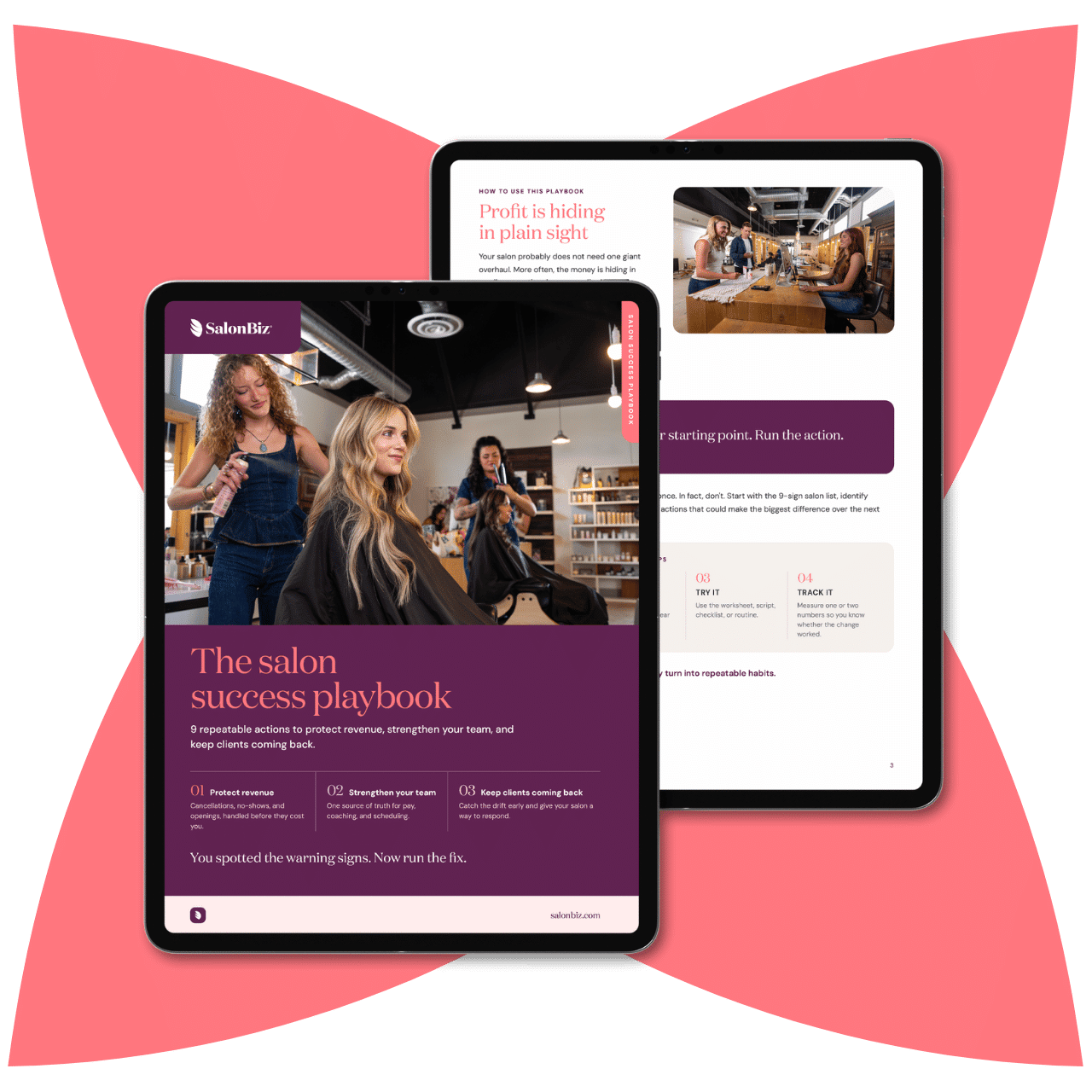
Grab our free playbook to quickly pinpoint where your salon is losing money and audit your operations on the fly.
You don’t need a demo. You need the right setup.
Contact [email protected] and our team will help you find the communication tools that fit your salon.
Losing clients? Learn why they leave and 7 proven strategies to win them back, including how automated marketing with SalonBiz does the outreach for you.

Salon staff training done right ties to real numbers. See how reporting, commission tracking, and scheduling turn coaching into retention.

Not sure where to start with your salon’s cancellation policy? Get the timeline, fees, examples, and how automation helps you enforce it.

There is no excerpt because this is a protected post.